
Start with understanding.
Not labels. Not comparisons. One everyday situation, one small step at a time.
Is there an online behavioural course for kids in India?
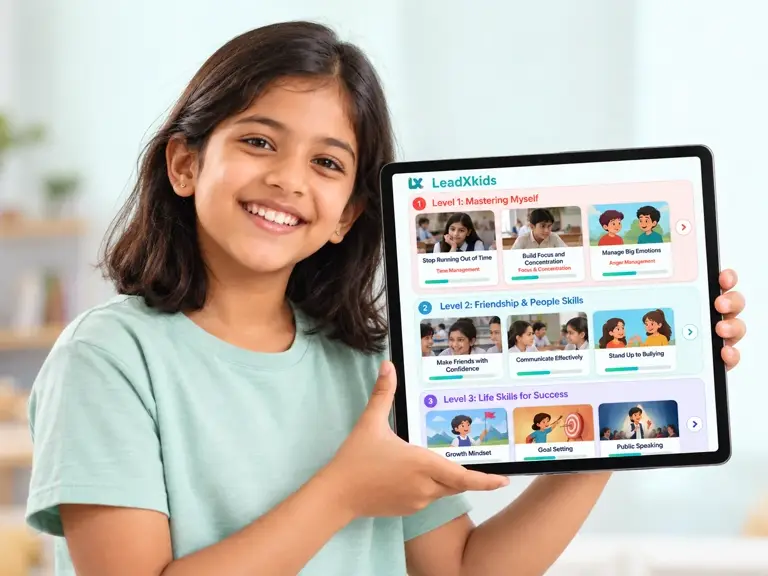
Yes. LeadXkids offers 20 psychologist-designed, story-based behavioural and life-skills courses for children aged 8–14, made for Indian families. Children learn online at their own pace on a phone, tablet or computer.
Behavioural learning here means practising everyday responses, not labelling a child as well-behaved or badly behaved. A child might explore how to speak when nervous, respond to a disagreement or pause before reacting. The courses use stories, choices and reflection rather than school-subject tuition.
Start with a situation your child recognises and choose one skill to practise. Ask what they noticed in the story rather than whether they got everything right. LeadXkids is an educational resource, not a diagnosis, therapy or a promise of a particular result.
How can I help my child manage anger?
Stay calm yourself, name the feeling ("you look really angry") and talk about it once your child has cooled down. Practise a simple routine together, such as stopping, taking slow breaths and then choosing what to say. Our course "Calm Down Before You Explode" walks children through these steps with stories and practice.
In the heated moment, focus on safety and a calm response rather than a long explanation. You can acknowledge the feeling while holding a boundary: being angry is understandable; hurting someone is not acceptable. Give your child space to settle, and return to the conversation when both of you can listen.
Later, explore what happened before the anger, how their body felt and what might help next time. Practise the routine during a calm moment, not only after an argument. If anger creates repeated safety concerns or serious distress, seek support from a qualified professional; a course is not a substitute for that help.
How do I build confidence in a shy child?
Give small, low-pressure chances to speak up, like ordering food or greeting a relative, and praise the effort rather than the result. Avoid labelling your child as "shy" in front of others. LeadXkids courses such as "Speak Without Freezing" and "Make Friends with Confidence" let children rehearse these moments safely first.
Quietness is not a flaw that needs fixing. Focus on helping your child do something they want to do, even when it feels uncomfortable. Agree on a small step together: asking one question in class, saying hello to a classmate or practising an introduction at home.
Let your child choose the pace and avoid comparisons with siblings or classmates. Notice specific effort, such as speaking despite feeling nervous, rather than demanding a confident performance. A story or rehearsal can be a starting point, but real-world practice should remain low-pressure and respectful.
What is social-emotional learning (SEL)?
Social-emotional learning (SEL) is how children learn to understand their emotions, get along with others, make responsible choices and bounce back from setbacks. It complements academic learning rather than replacing it. LeadXkids teaches SEL skills through stories, choices and reflection.
SEL brings together skills such as noticing feelings, listening to another perspective, working through disagreements and thinking about consequences. These are useful in ordinary situations: a group project, a difficult homework task or a change in friendship. SEL is not about expecting a child to be cheerful or calm all the time.
At home, you can make space for these skills by talking about a situation without judging the child. Ask what they felt, what the other person may have felt and what they would like to try next. LeadXkids uses stories and reflection to give these conversations a practical starting point.
What age is LeadXkids for?
LeadXkids is designed for children aged 8 to 14. Stories, examples and language are pitched for this age group, and parents get their own account to follow progress.
Children within this age range can still differ in reading comfort, interests and readiness for independent learning. Use the course descriptions and your child's response to the examples to judge whether a topic feels relevant. Age alone does not tell you which skill your child needs to practise first.
A parent can help with getting started and checking in without turning every lesson into a test. Let your child explain an idea in their own words. The aim is to support learning at a comfortable pace, not to compare their progress with another child's.
Who designed the courses?
The courses are psychologist-designed and built by the LeadXkids team, founded by Anvith Murthy in Bengaluru. Anvith is a former HR leader (CHRO at Rapido) with psychometric certification and a behavioural coaching background.
The founder's background and the course-design claim are distinct. HR leadership, psychometric certification and behavioural coaching describe Anvith's experience; they should not be read as a claim that he is a clinical child psychologist. The About page explains the team's background and the platform's approach.
For information on how public material is prepared, consult the editorial policy and published reviewer information. Do not treat the phrase psychologist-designed as a guarantee of outcomes, clinical treatment or an independently validated assessment of your child.
How is it different from tuition or activity classes?
Tuition focuses on school subjects and marks, and activity classes teach a hobby. LeadXkids focuses on everyday behaviour and life skills: confidence, emotions, friendships, focus and decision-making. It is self-paced, so there are no fixed class timings.
A child can be doing well academically and still find it difficult to ask for help, handle teasing or recover after a mistake. Those situations call for practice beyond a subject lesson. LeadXkids addresses these everyday skills through scenarios and reflection, rather than homework support or exam preparation.
It can sit alongside school and activities rather than replace them. Choose a topic because it relates to your child's current experience, not because you want to add another achievement to their timetable. Leave time to try the skill away from the screen.
How much does it cost?
Quarterly membership is ₹1,499 for 3 months and Annual membership is ₹1,999 for a full year, both covering all 20 courses. Annual also includes the Know Your Child Assessment. Plans are one-time payments with no auto-renewal.
Choose a membership based on the access period that suits your family, rather than how quickly you expect your child to change. There are no scheduled classes to attend. Annual includes the Know Your Child Assessment; the free confidence check is a separate resource and does not require buying a membership.
The amounts above are Indian prices. Visitors outside India should use the price and currency displayed on the plans and payment pages. Before paying, check the selected plan, access period and refund terms. This guide does not change the membership terms or payment process.
Can schools use LeadXkids?
LeadXkids is currently built for families at home. Schools interested in using it can write to hello@leadxkids.com to discuss options.
A school can contact the team to explain the ages involved, the skills it wants to support and how it expects children to use the material. This is an enquiry, not a claim that a school programme, classroom licence or specific institutional package is already available.
Do not assume a family membership includes school-wide access. Any school arrangement, safeguarding responsibilities and handling of children's information should be clarified directly with the team before use.
How long does a course take?
Each course is split into short 5–10 minute story-based units. Most children finish a course over 2–4 weeks with about 10 minutes a day, but they can go faster or slower.
The time guidance is a planning estimate, not a deadline or a promise. Some children like to repeat a story or pause to discuss an activity; others move through the material more quickly. Short sessions can fit into a family's routine without making the course another daily pressure.
Look beyond completion to whether your child can recognise a situation and try one idea in everyday life. Leave room for reflection and practice between sessions. If a lesson feels tiring or upsetting, pause and talk rather than insisting on finishing it that day.
Does my child need a parent to sit with them?
No. Children can use LeadXkids on their own once you have set up their profile. Parents can see progress and reflections from the parent account.
Independent use does not mean a child must handle every difficult topic alone. You can be available for questions while giving them room to make choices and reflect. Younger children or children who find reading demanding may prefer occasional help.
A useful check-in is to ask which part felt familiar and whether there is something they want to try. Avoid turning their reflections into a judgement of their behaviour. If they mention bullying, fear or harm, respond to the real situation and involve appropriate adults rather than relying on a lesson to resolve it.
Which devices does LeadXkids work on?
It works in any modern browser on Android phones, iPhones, tablets and computers. You can also install it as an app from the browser for quicker access.
Choose a device your child can use comfortably, with text they can read and space to hear or follow the lesson. A larger screen may be useful for some families, but it is not a requirement. A modern browser is the starting point; no separate device purchase is needed just to view the public resources.
Installing the website for quicker access does not change membership or assessment access. Internet availability and the device's settings can affect use. On a shared device, keep parent account access private and sign out when appropriate.
Are there games, points or leaderboards?
No. LeadXkids deliberately avoids points, streaks and leaderboards so children focus on the skill rather than on rewards. Progress is shown simply as course completion.
The intention is to keep attention on the skill rather than collecting rewards or comparing children. Completion shows where your child has reached in a course; it is not a ranking of character, maturity or future potential.
You can reinforce this at home by asking about a useful idea instead of how much they completed. Repeating a lesson or taking time over a reflection is not a failure. Progress in everyday behaviour can be uneven, and the platform does not promise a fixed pace of change.
Is there a free way to try it?
Yes. Parents can take the free confidence check and use our free parent tools and Parent Library guides before buying a membership.
Use a free resource to explore a question that matters to your family before deciding whether a paid course is a good fit. A confidence check can prompt reflection, while a Parent Library guide or practical tool can help you begin a conversation at home.
Free resources are educational starting points, not a diagnosis or a comprehensive picture of your child. You do not need to interpret a check result as a permanent label. The Know Your Child Assessment is separate and has its own access and report flow.
What is the Know Your Child Assessment?
It is a parent and child questionnaire that produces a parent-friendly report on your child's strengths and growth areas. It is included with Annual membership and is separate from the free confidence check.
The assessment brings parent and child perspectives together to support understanding and conversation. Differences in their responses can reflect what each person notices in different situations. They should not be treated as proof that one person is right or that the child has a problem.
The report is educational and is not a medical or mental-health diagnosis. Read it alongside your child's everyday experiences rather than using it as a fixed identity or prediction. You can inspect the sample report before choosing access, and discuss significant concerns with a qualified professional.
Find a skill that fits your child.
Explore the course topics together, without pressure to do everything at once.
Explore all courses